
Loctite in Preventive Maintenance: Adhesive Solutions That Extend Machine Lifecycles
Key Takeaways
🔸Loctite threadlockers prevent fastener loosening: Vibration-resistant adhesives eliminate the primary cause of unexpected machine failures in manufacturing environments.
🔸Preventive maintenance schedules reduce downtime: When fasteners don’t loosen randomly, maintenance teams is able to schedule servicing based on actual usage rather than reacting to failures.
🔸Data centers rely on Loctite for cooling system reliability: Server room cooling equipment uses Loctite threadlockers preventing vibration-loosened connections that could cause temperature spikes.
🔸JZ Industry supplies genuine Loctite products: As an authorized Loctite supplier in Johor Bahru (JB), we provide genuine threadlockers with technical support for application selection.
Introduction
Bolts loosening in the cooling system’s compressor compromises equipment performance, potentially causing overheating and triggering automatic shutdowns. Continuous vibration gradually loosens critical fasteners, leading to component misalignment and service interruptions.
The resulting downtime can be costly, in some cases exceeding RM50,000 due to service disruptions, emergency repairs, and overtime labor. Equipment may look secured with mechanical fasteners after assembled; however, with ongoing vibration, bolts & nuts may loosen over time.
This is not an isolated incident. Similar failures occur across manufacturing plants and data centers throughout Johor Bahru (JB). In this guide, we examine how Loctite threadlockers help prevent fastener loosening, support more effective maintenance planning, and extend equipment lifespan in high-vibration operating environments.
How Do Vibrations Cause Fastener Failures?
Vibration creates micro-movements between threaded fasteners causing them to progressively loosen over time, even when properly torqued during installation. This loosening happens gradually, making it difficult to predict when failures will occur.
Manufacturing equipment, HVAC systems, and industrial machinery generate constant vibration during normal operation. Every vibration cycle creates tiny movements between threads. These movements accumulate over thousands of cycles, gradually reducing clamping force until fasteners become loose enough to cause component misalignment, excessive wear, or complete failure.
Visual inspections can’t detect early-stage loosening. By the time looseness becomes visible, significant damage may have occurred. Without threadlockers, maintenance teams can’t predict when fastener failures will occur, forcing reactive maintenance where teams respond to failures rather than preventing them.
What Are Loctite Threadlockers and How Do They Work?
Loctite threadlockers are liquid adhesives applied to threaded fasteners before assembly that cure into solid polymer filling gaps between threads, preventing vibration-loosening while maintaining disassembly capability. Different formulations provide varying strength levels for different applications.
Threadlockers remain liquid during application, flowing into microscopic gaps between threads. When assembled, the lack of oxygen triggers curing. The liquid transforms into a tough thermoset plastic locking threads together.
Strength Grades:
Low Strength (Purple – Loctite 222): Easy removal with hand tools for frequent adjustments. Used on small fasteners (<M6) requiring regular servicing.
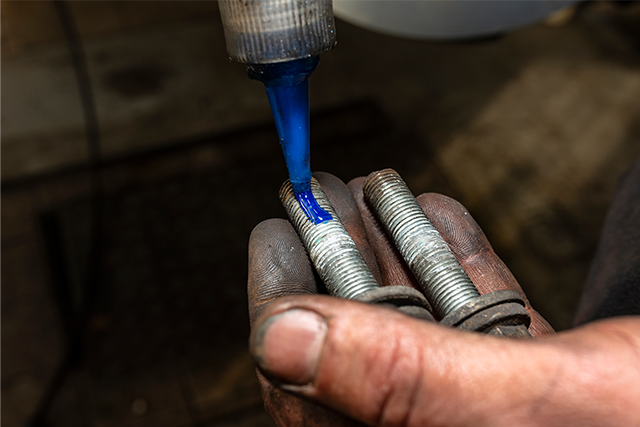
Medium Strength (Blue – Loctite 243, 248): Removable with hand tools but prevents vibration loosening. Most common grade for general machinery, pumps, motors, and equipment requiring occasional disassembly for maintenance.
High Strength (Red – Loctite 263, 270, 277): Permanent assembly requiring heat for removal. Used on critical fasteners that should never loosen during equipment lifespan.
Threadlockers typically reach handling strength in minutes to hours, with full cure achieved in 24 hours. Cure time may vary with metal type, temperature and thread size.
How Does Loctite Enable Preventive Maintenance?
Preventive maintenance schedules regular servicing at planned intervals to prevent equipment failures before they occur. Loctite threadlockers support preventive maintenance by eliminating fastener loosening as a failure mode, allowing maintenance teams to focus on actual component wear.
Traditional maintenance follows either reactive approaches (fix when broken) or preventive approaches (service at regular intervals). Reactive maintenance causes unexpected production losses and emergency repairs. Preventive maintenance schedules servicing based on time or usage cycles, but unexpected fastener failures can still disrupt schedules.
With Loctite preventing fastener loosening, maintenance teams can rely on preventive maintenance schedules without worrying about random fastener failures between service intervals. Teams focus on actual wear indicators like bearing noise, vibration analysis, and temperature monitoring. Fasteners secured with threadlockers don’t require torque checking during routine maintenance, simplifying preventive maintenance procedures.
Johor Bahru (JB) data centers implement preventive maintenance programs extensively. Cooling systems secured with Loctite threadlockers allow maintenance teams to schedule servicing based on operating hours and equipment condition monitoring without concern about fasteners loosening unexpectedly between scheduled maintenance intervals.
What Fastener Applications Benefit Most from Loctite?
High-vibration equipment, critical safety components, and assemblies requiring long service intervals benefit most from threadlocker application. These applications justify threadlocker cost through improved reliability.
- High-Vibration Equipment
– Pumps generating constant vibration
– Compressors with reciprocating motion
– Motors with rotating components
– Cooling fans in data centers and manufacturing facilities
- Safety-Critical Assemblies
– Machine guards protecting workers from moving parts
– Fall protection anchor points
– Lifting equipment attachment points
- Hard-to-Access Fasteners
– Fasteners inside enclosed equipment housings
– Overhead installations requiring scaffolding
– Submerged or buried components
Threadlockers eliminate loosening between infrequent inspection opportunities, improving equipment reliability.
How Do You Select the Right Loctite Grade?
Choose threadlocker based on required strength, fastener size, disassembly needs & operating temperature.
| Application Type | Recommended Grade | Reason |
| Frequent adjustment fasteners | Low Strength (Purple 222) | Easy hand-tool removal |
| General machinery bolts | Medium Strength (Blue 243/248) | Vibration resistance, removable |
| Permanent assemblies | High Strength (Red 263/ 270/277) | Maximum security, improve reliability |
| High-temperature equipment | High-temp formulations (Red 272) | High-temp resistance up to 230°C |
Standard threadlockers work from -55°C to 180°C covering most industrial applications. Data center cooling equipment and most manufacturing machinery operate within this range. High-temperature formulations handle up to 230°C for exhaust systems, ovens, or hot equipment.
Small fasteners (M6 and below) work with any strength grade. Medium fasteners (M8-M20) typically use medium strength for serviceability. Large fasteners (M24+) may use high strength for permanent assemblies or medium strength with proper torque specifications.
Pro Tip: When in doubt, please contact a Loctite supplier in Johor Bahru (JB) like JZ Industry for support.
Why Choose Authorized Loctite Suppliers?
Authorized suppliers provide genuine Loctite products with proper storage, technical support, and application guidance ensuring product effectiveness. Counterfeit or improperly stored threadlockers don’t cure correctly.
As an authorized Loctite supplier in Johor Bahru (JB), JZ Industry sources directly from authorized distributors. Products arrive with proper shelf life remaining and storage under temperature-controlled conditions. We provide technical data sheets, safety information, and application guidance.
Genuine Loctite bottles include batch codes, expiration dates, and tamper-evident seals. We help customers select appropriate grades for specific applications and provide problem-solving when standard applications don’t work as expected.
We maintain stock of commonly used grades ensuring availability when maintenance teams need products. Bulk purchasing options for high-volume users. Organized storage allows easy selection of correct products.
Conclusion
Loctite threadlockers transform unpredictable fastener maintenance into reliable, scheduled servicing by preventing vibration-loosening. This predictability reduces emergency repairs, extends equipment lifecycles, and enables true predictive maintenance approaches in Johor Bahru’s manufacturing and data center facilities.
Contact a Loctite supplier in Johor Bahru (JB) like JZ Industry for Loctite product selection guidance. As an authorized supplier in Johor Bahru (JB), we’ll help identify appropriate threadlocker grades for your specific machinery, provide genuine products with full technical support, and assist in implementing threadlocking procedures that reduce maintenance costs and improve equipment reliability.
Frequently Asked Questions (FAQ)
Yes, most Loctite threadlockers are designed for disassembly. Low strength (Purple 222) and medium strength (Blue 243/248) remove easily with standard hand tools at room temperature. High strength (Red 263/270/277) requires heat application (typically 250°C) to soften the polymer before disassembly. For equipment requiring frequent maintenance access, specify medium-strength threadlockers providing both vibration resistance and serviceability without special tools.
Loctite threadlockers begin curing within minutes of assembly. Threadlockers typically reach handling strength in minutes to hours, with full cure achieved in 24 hours. Cure time may vary with metal type, temperature and thread size. Fixture time (when parts can be handled) occurs within 10-30 minutes for most formulations. Equipment can usually be returned to service after several hours, but full load capacity requires complete curing. Temperature affects curing speed, warmer conditions accelerate curing while cold slows the process. Don’t torque-check fasteners until full cure is achieved.
Common curing problems include contaminated threads (oil, grease preventing contact), passive metal surfaces (stainless steel, plated fasteners), expired product (degraded chemistry), improper storage (heat or cold affecting chemistry), insufficient gap fill (very loose thread fit), and extreme temperatures during curing. If experiencing curing problems, contact JZ Industry for troubleshooting. We can recommend primers, activators, or alternative formulations addressing specific application challenges.
Unopened Loctite bottles typically have 12-24 month shelf life depending on formulation. Store threadlockers in cool, dry conditions away from direct sunlight and heat sources. Temperatures between 15-25°C are ideal. Once opened, use products within 6-12 months for best performance. Check batch codes and expiration dates printed on bottles. JZ Industry maintains properly stored inventory ensuring customers receive products with maximum remaining shelf life.
Contact JZ Industry directly for Loctite threadlocker consultation and supply. We provide technical guidance on product selection, application procedures, and bulk purchasing options. Our team helps identify appropriate threadlocker grades for specific machinery and operating conditions. Visit our website at jzindustry.net or call our Johor Bahru office to speak with technical specialists who understand local manufacturing requirements and can recommend solutions based on your equipment needs.